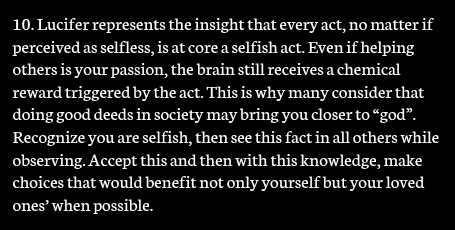
So I think the response would be something along the lines of since you hold them dearly, benefiting them feels good. You are not doing it for that person, you are doing it because of your own feeling of “holding dearly.”
But the thing I have a problem is that psychological egoism (which is what this belief is called) is kinda… pointless.
So I remember when I was in highschool I heard that all action was motivated by the need to be important. I thought about it for days, going over over everything people did and seeing that it fit, even things that on the surface contradicted. I had the thought that:
Then I heard of psychological egoism. Went through the same thought process and came to the same conclusion. At that point I was realized something was amiss. How can these both be true at the same time?
The reason is the way these beliefs are proven.
- Find an example that contradicts your theory.
- Reframe the example to match your theory.
- Wow! The theory holds up.
So it could be
- In a country plagued by famine a mother goes without food so that her children may eat.
- In a country plagued by famine a woman goes without food to preserve her genetic lineage and feels pleasure at seeing children eat.
- Wow! Psychological egoism holds up.
The thing is that since you can reframe anything to be anything there is no way to falsify it. Thus it can’t really be tested. People do this for egoism, importance, altruism, environmentalism, hedonism and who knows what else. You can make up your own.
A second problem I have specifically with psychological egoism, is the particular way it reframe examples. You show someone doing something selfless and it is reframed as them fulfilling some personal value, thus they are getting pleasure from it. At that point you could just reword it as “people are motivated by their motivations” and it suddenly becomes way less profound.
A third problem is that I can’t really use this information. If I meet two people, one leaning more selfish and the other more selfless, I will treat them differently because different things make them tick so to have smooth interactions I adapt to their styles. But then someone walks in and says they are both selfish. Great, what am I suppose to do with that information? They still have different personalities, and knowing that deep down they are the same makes no difference. IDK, a theory that explains everything, explains nothing.
Fourth, it is just kinda a weird framing of things. Aristotle thought that someone who does good and wants to do good is superior to someone who does good but has to force themselves. But I guess in modern times this has been reversed. What was once virtuous is now selfish. Imagine finding out your significant other was only nice to you out of obligation, would you be happy that they are being so selfless? or heartbroken?
I guess the conclusion here is that example you gave could be reframed to still be selfish, but I don’t think it matters.